


Greenhouse gas emissions in the SSPs-CH 
For the modeling of possible greenhouse gas emissions of the individual SSP-CH, INFRAS and PROGNOS used existing results for sectors as a basis for the construction of a highly simplified modular model (reduced complexity model).
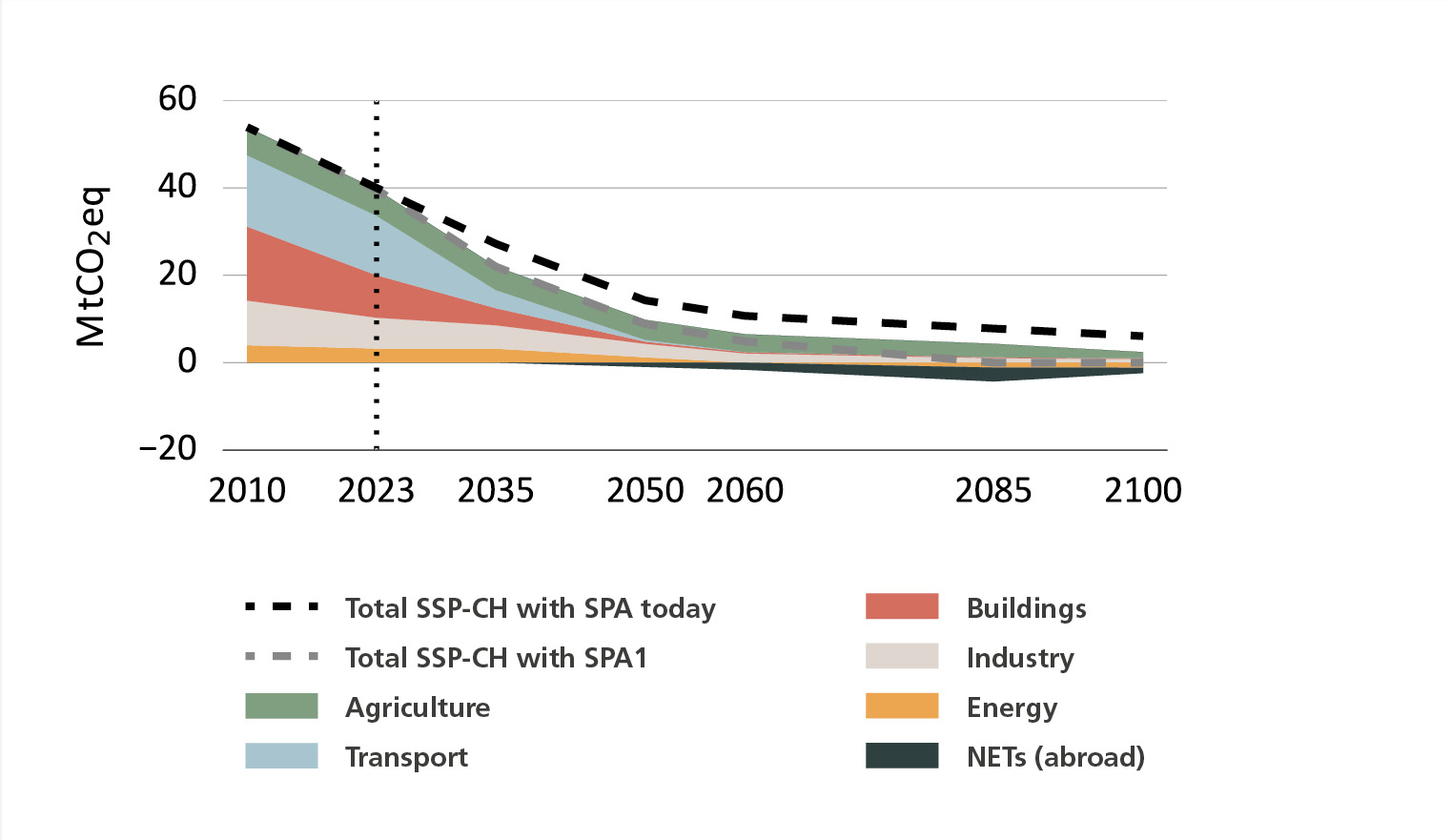
The results illustrate the impact of socio-economic developments and policies on GHG emissions:
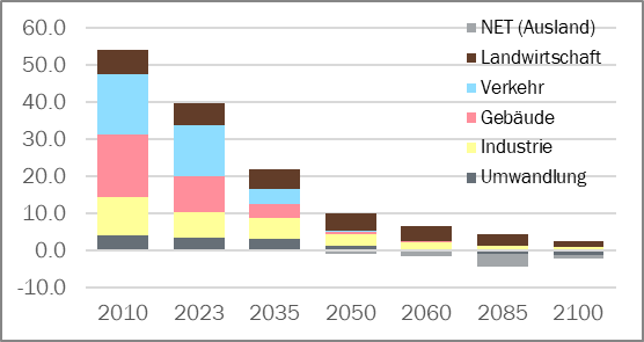
Frugal Switzerland with a participatory climate policy (SSP0-CH &SPA2)
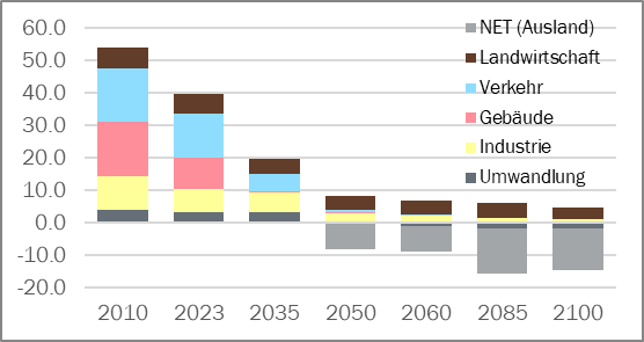
Efficient Switzerland with a guiding climate policy (SSP1-CH & SPA1)
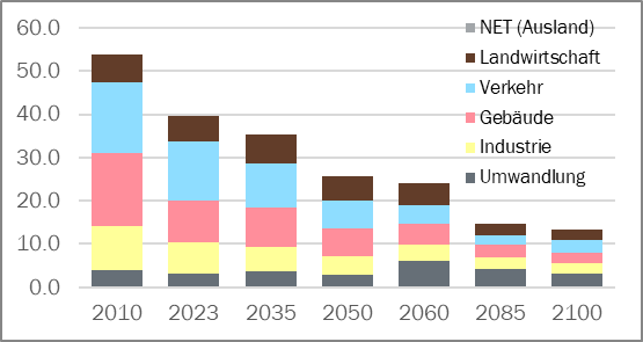
Conflict-prone Switzerland with minimal climate policy (SSP3-CH & SPA3)
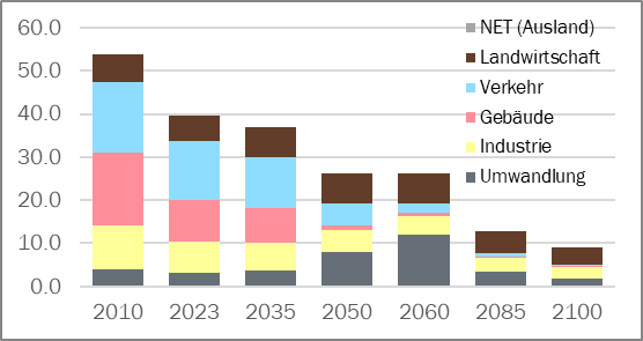
Unequal Switzerland with minimal climate policy (SSP4-CH & SPA3)
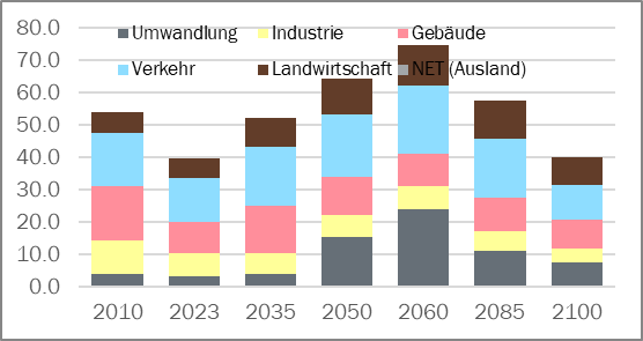
Resource-intensive Switzerland without a climate policy (SSP5-CH & SPA4)
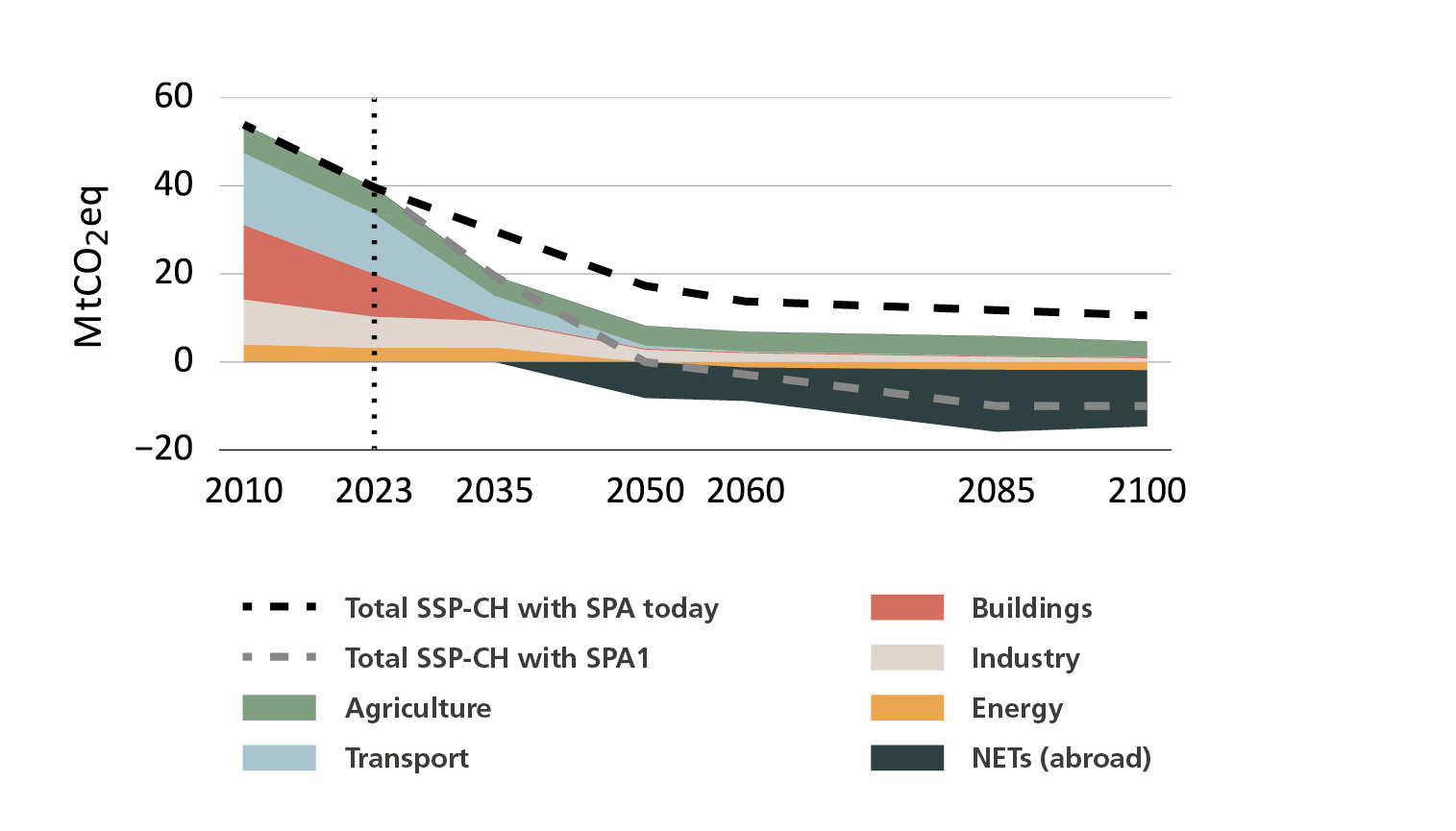
- Previous developments in environmental awareness, technology and efficiency, as well as climate policy to date, act as robust drivers for reducing emissions this century. Under the assumptions of SSP1-CH Efficient Switzerland and SSP0-CH Frugal Switzerland scenarios, emissions will fall significantly over time, even without further political intervention. This is primarily due to high environmental awareness among the population, coupled with
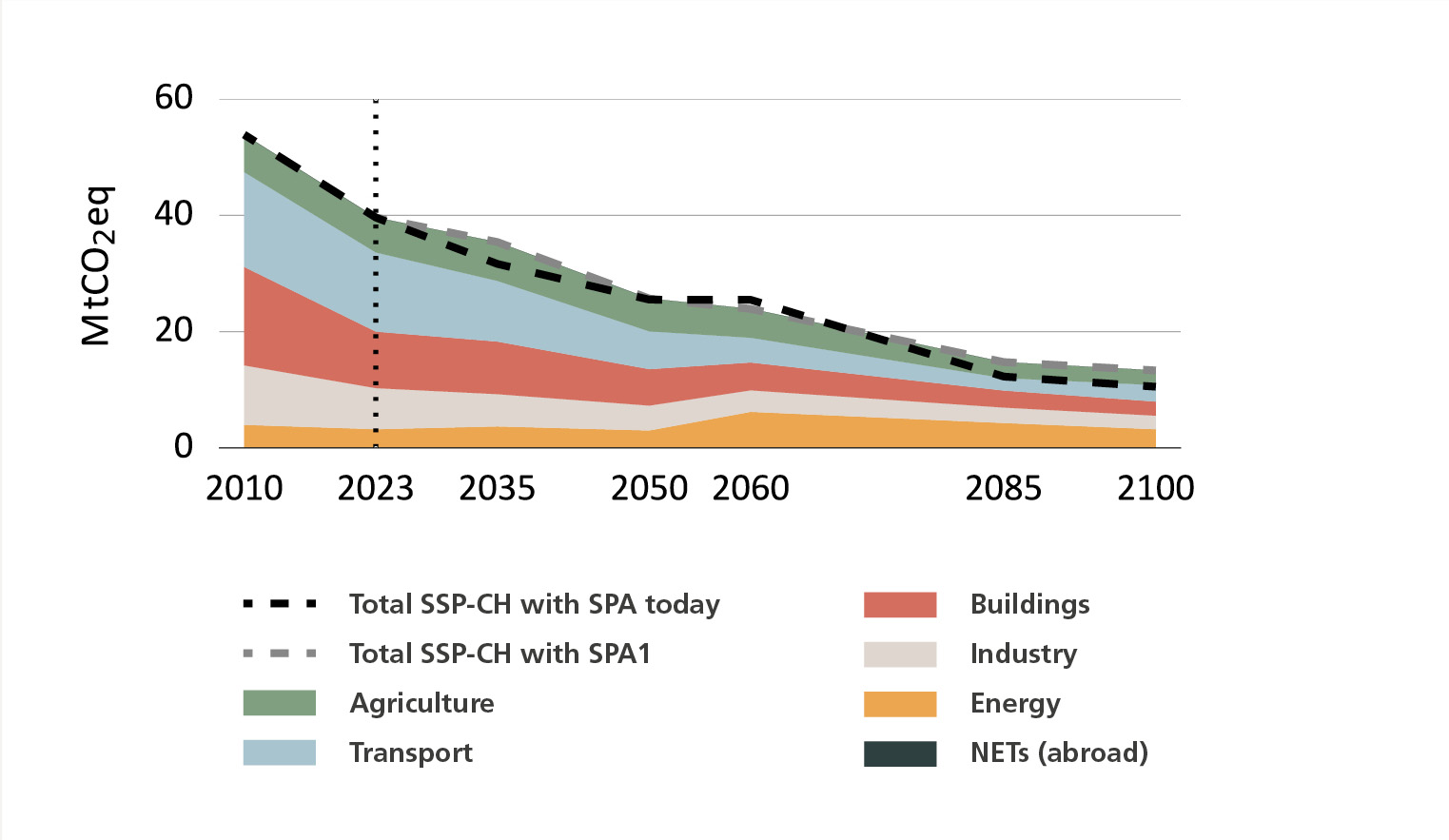
increased efficiency (SSP1-CH) or consciously reduced consumption (SSP0-CH). However, the net-zero target will only be achieved in both SSP-CH scenarios with additional climate policy instruments. - Negative economic development, reduced international relations and a loss of prosperity, as assumed in SSP3-CH Conflict-Prone Switzerland, also lead to a reduction in greenhouse gas emissions in Switzerland in the long term.
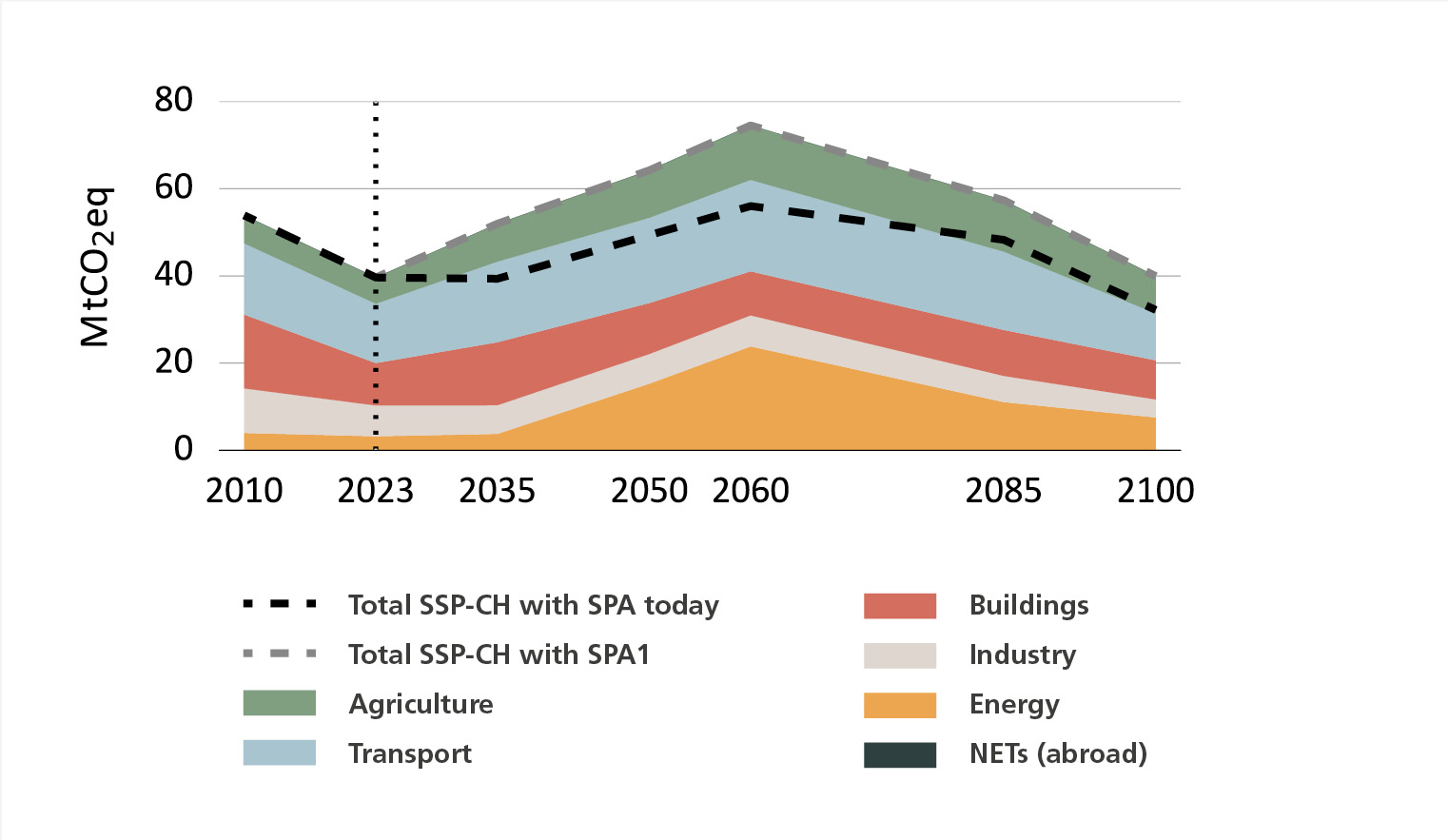
- In SSP5-CH Resource-Intensive Switzerland, emissions rise sharply due to strong, resource-intensive growth and the extensive dismantling of climate policy instruments. In the long term, the emissions return to current levels due to economic contraction.
Fundamentally, the ‘societal climate’ depicted in the socio-economic scenarios SSP-CH has a major influence on the development of emissions: this encompasses the continuation of the existing climate policy framework, as well as societal developments and policies that do not directly pursue climate targets. Emissions are thus influenced indirectly, for example by triggering developments in other societal areas that have an impact on the climate, such as environmental awareness within society or technical innovation. An ambitious climate policy, however, is necessary in all scenarios to achieve the net-zero target or, in some scenarios, to even become net-negative in the second half of the century.
Generally speaking, all model results covering the long period up to 2100 should be regarded as illustrative, even though the model can quantitatively capture potential interrelationships within an overall system. However, by their very nature, both the underlying data – the SSPs-CH and SPAs – and the energy, emissions and land-use modelling over such a long period are subject to very significant uncertainties and limitations. Nevertheless, the model results can help to systematically examine various possible and consistent future developments (INFRAS, PROGNOS, WSL 2026).

Possible greenhouse gas emissions for the following four combinations of Shared Socio-economic Pathways (SSPs-CH) and Shared Policy Assumptions (SPAs):
SSP1-CH & SPA1
SSP5-CH & SPA4
SSP3-CH & SPA3
SSP0-CH & SPA2
Further results can be found in the technical report on greenhouse gas modeling.
Downloads and documentation 
Summary:
INFRAS, PROGNOS, WSL (2026): Greenhouse gas emissions under different socio-economic and climate policy scenarios for Switzerland. Summary. National Centre for Climate Services (NCCS) (ed.), Zurich. http://doi.org/10.55419/wsl:42762
The technical report (only german):
Oberpriller, Q., Schmid, N., Kemmler, A., Gubler, L., Bogler, Giger, D., S., Piegsa, A., Brutsche, A., Kreidelmeyer, S., Vu M. Ph., Black, B., Kirchner, A., Füssler, J. (2026): Treibhausgasemissionen unter verschiedenen sozioökonomischen und klimapolitischen Szenarien für die Schweiz. Modellierung und Analyse. Infras, Prognos, WSL. Zürich. http://doi.org/10.55419/wsl:42766
(see also Menu Publications).
The underlying data can be foundhere.