


Shared Socio-economic Pathways (SSPs-CH) 
Scenario development 
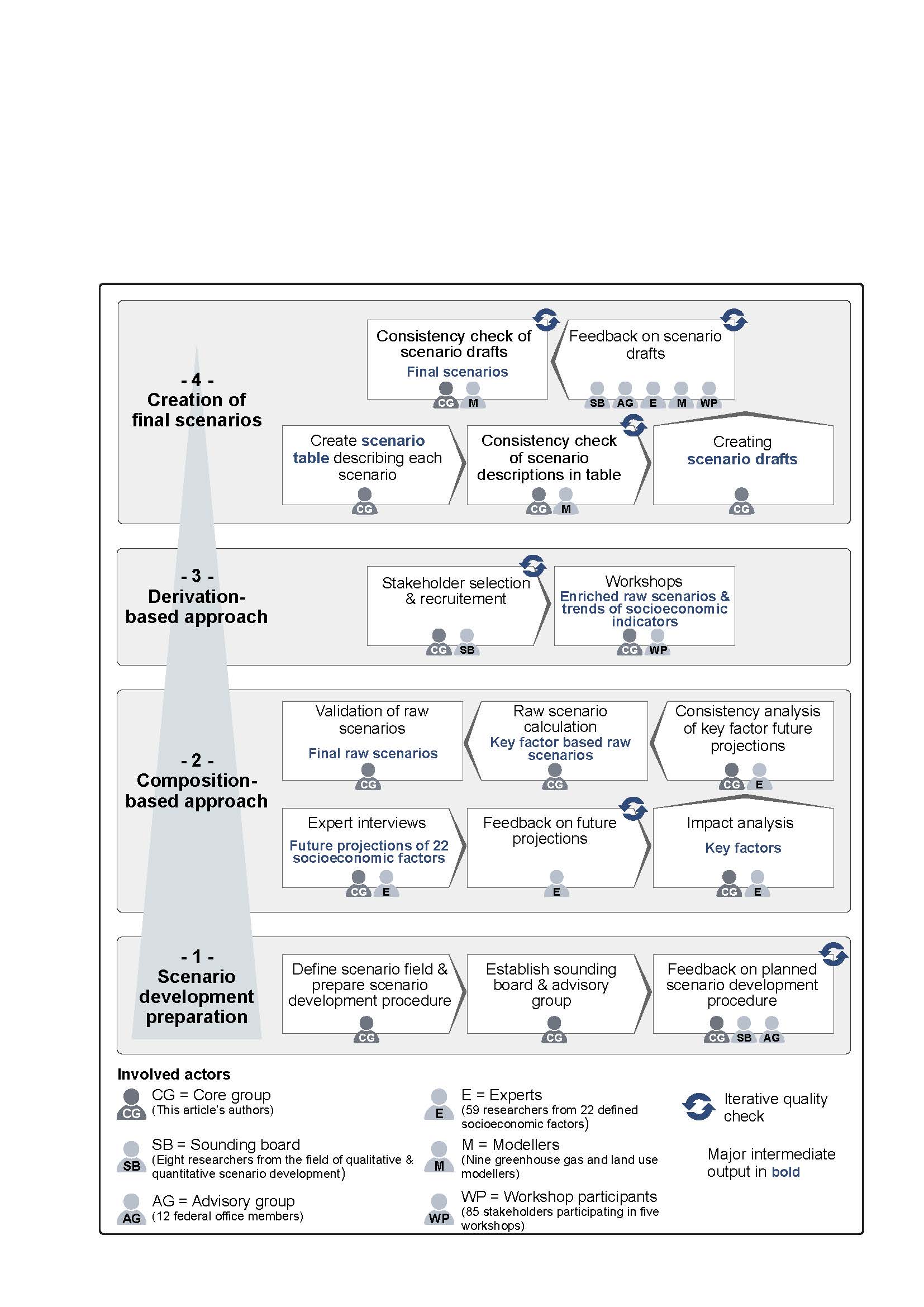
Future studies employ various methods and approaches for short-term forecasting, medium-term trend analyses, normative target scenarios, or visions and ideal scenarios. The SSPs-CH are explorative scenarios: they are consistent, plausible and easily distinguishable scenarios that sound out different possible socioeconomic developments. This should help to identify current challenges and derive options for action.
The SSPs-CH do not contain any best- or worst-case scenarios. All the futures described contain both positive and negative aspects. Each scenario is consistent in itself, although alternative combinations of individual characteristics are also conceivable. These combinations of developments have been put together in such a way that they are internally consistent and, taken together, cover a broad future space. No statements are made on the probability of occurrence of the scenarios - it is therefore neither possible nor expedient to use individual scenarios in isolation as a basis for planning. Rather, the SSPs-CH serve exclusively to compare different developments within the realm of possibility and to use them as a basis for discussion and decision-making.
Like all prospective work, the SSPs-CH are based heavily on the assessment and knowledge of experts:
Focus discussions with 59 scientists from 20 Swiss scientific institutions formed the basis for the scenarios. Possible future characteristics (projections) were developed for 22 factors. The resulting projections were bundled into four plausible, internally consistent and clearly distinguishable scenarios in a software-based consistency analysis; a further scenario was derived from the projections based on the global SSPs. These scenarios were then discussed, enriched and consolidated in five workshops with a total of 85 participants from German-speaking and French-speaking Switzerland.
There are two key differences compared to the global SSPs: Firstly, the sustainability scenario is divided into an efficiency-oriented variant (SSP1-CH) and a development based on changing consumption patterns (SSP0-CH). Secondly, the globally assumed fossil-innovative pathway (SSP5) is considered implausible for Switzerland; instead, SSP5-CH describes a development that is less innovative and unstable in the long term. An SSP2 (‘Middle of the Road’) was not developed for methodological reasons.
This resulted in the SSPs-CH, the short version of which can be read here:
SSP0-CH: Frugal Switzerland 
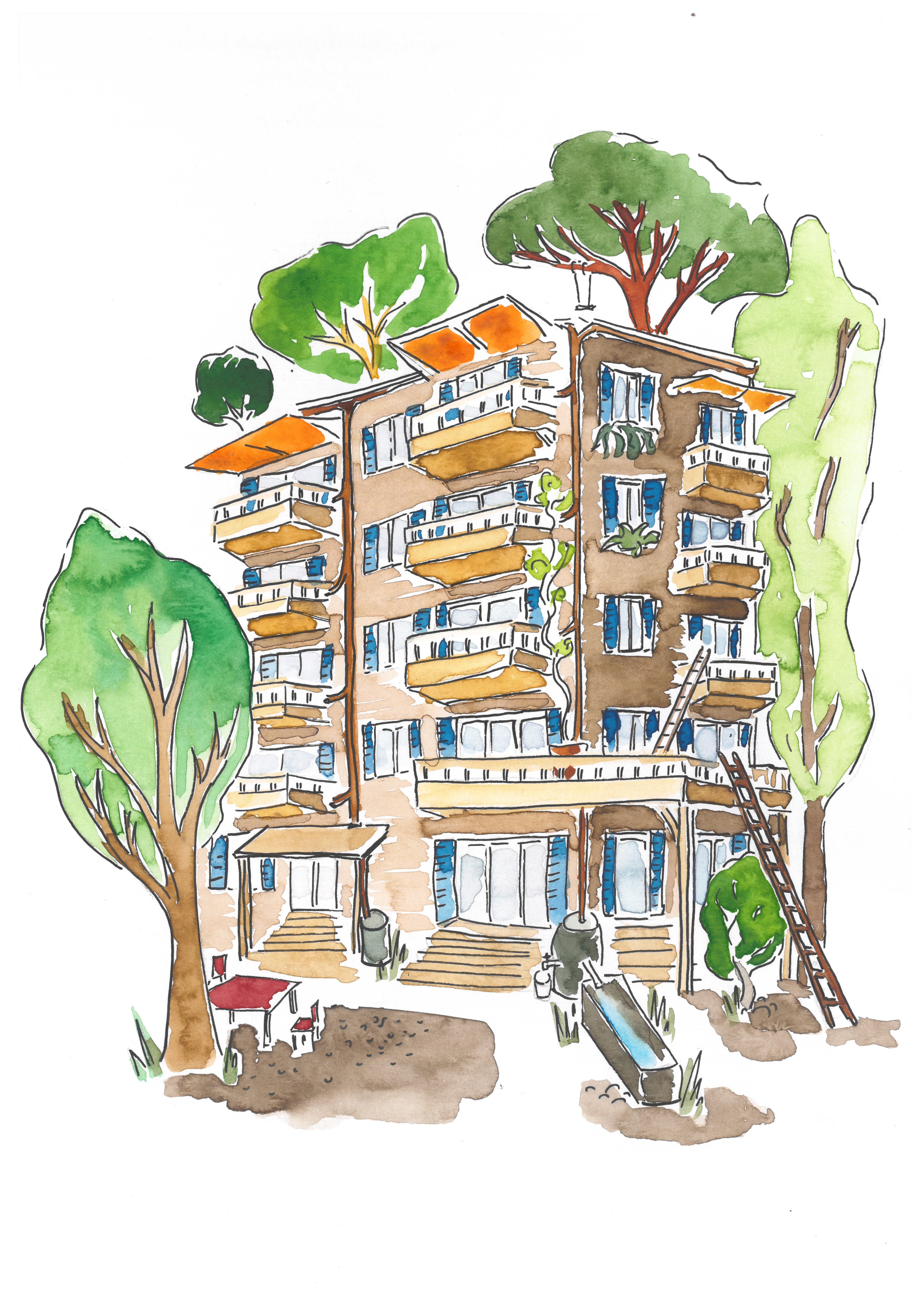
The Swiss population is heavily involved in political and social life. It has a strong sense of community and solidarity. The welfare state is well developed and trust in political institutions is high. People consume less: items and products have a longer lifespan, energy is saved and the distance traveled per day has fallen. Economic output has fallen overall. Although the birth rate has risen slightly, the resident population has decreased: Due to increased quality of life abroad and reduced job opportunities in Switzerland, fewer people are immigrating. Far-reaching redistribution measures have affected the distribution of income and financial wealth among the population. Prosperity and living standards have fallen, but well-being is high. Regional centers and urban districts have been strengthened and offer sufficient basic services. The population is rooted locally. Switzerland's level of self-sufficiency in food and energy production is high, partly because energy consumption has fallen sharply and diets have changed. Food is grown sustainably. Political relations with the federally organized European Union (EU) are close and Switzerland is involved in European activities. European and global political challenges are tackled in an internationally coordinated manner. The global economy is less interconnected than it is today.
System diagram SSP0-CH (german) 

Impact diagrams illustrate the high system complexity and interactions of individual factors (no claim to completeness). Click on the image to explore the interactive impact diagram. Move the mouse over the gray circles of the connecting arrows and click on the info sign to obtain information on the individual parameters or the interactions between the parameters.
SSP1-CH: Efficient Switzerland 

Swiss society focuses on efficiency and sustainability. Political processes and institutions function reliably, and the population trusts both. Standardized administrative processes have led to certain competencies becoming more centralized. With the help of efficiency-enhancing technologies, the economy has developed into a circular economy, which has greatly reduced resource consumption and waste generation. Other areas of society, such as healthcare and mobility, are also highly technologized and efficiently organized. High innovation rates and efficiency gains lead to a highly productive economy. The profits from this increase in productivity benefit the entire population through redistribution. Economic output is growing steadily at a moderate level - partly due to continued immigration and a stagnating birth rate. Land use is organized very efficiently. The cities are very densely populated. Most food is imported. the remaining agricultural production is technologized and makes optimal use of land. Energy production is based 100 percent on renewable energy sources from Switzerland and abroad. Switzerland maintains close political and economic relations with other countries, particularly the EU. The population holds both individual freedom and the common good in very high regard.
System diagram SSP1-CH (german) 

Click on the image to explore the interactive impact diagram. Move the mouse over the gray circles of the connecting arrows and click on the info sign to obtain information on the individual parameters or the interactions between the parameters.
SSP3-CH: Conflict-prone Switzerland 

The prosperity of the Swiss population has declined. Politics is polarized, solution-oriented compromises are hardly possible. Corruption and clientelism are on the rise. Companies and the state are hardly investing in new technologies, which is leading to rising prices, falling exports and declining quality. The influx of foreign skilled workers is ebbing as innovation and investment decline, and economic output is falling. Unemployment is rising and many people are emigrating. Due to limited state financial resources, welfare state services are being cut back. Investments in renewable energies and agriculture are stopped due to a lack of funds. The production volume shrinks and with it the economy, many companies are forced to close. International relations are only being maintained to a minimum, and Switzerland is becoming increasingly isolated. It is becoming increasingly difficult to provide basic services to the population. The population, which moved to the cities in the second half of the century to find work there, is increasingly returning to the countryside in order to provide for itself. Social groups and family ties provide social security. Conflicts over resources increase. The state uses its meagre resources to maintain internal security. The EU still exists, but has lost many member states. International networking and trade agreements are also greatly reduced; international organizations have lost relevance.
System diagram SSP3-CH (german) 

Click on the image to explore the interactive impact diagram. Move the mouse over the gray circles of the connecting arrows and click on the info sign to obtain information on the individual parameters or the interactions between the parameters.
SSP4-CH: Unequal Switzerland 

Swiss society is divided. An elite dominates the economic and political scene. This elite is well connected internationally and cultivates a resource-intensive lifestyle. Thanks to productivity-enhancing technologies, the economy will continue to grow until the end of the century. It is mainly the elite that benefits from the resulting productivity gains, while employment opportunities for the middle classes are increasingly disappearing or shifting to the low-wage sector. Highly specialized skilled workers are recruited internationally, migration is strictly regulated and geared towards the needs of the labour market. The population decreases in the second half of the century. The strong state creates optimal framework conditions for the increasingly export-oriented economy, while reducing or privatizing welfare state services such as education, care and healthcare. Access to basic services and social security is not guaranteed. They are becoming unaffordable for a large proportion of the population. This leads to major differences in education levels and life expectancy. The strong polarization is also reflected spatially: the elite live in secure, spacious neighbourhoods, while the former middle class live in dense agglomerations. Overall, the population is declining. Switzerland imports most of its energy. Large industrial farms cultivate the Central Plateau. Due to the abandonment of agriculture in the Alps and Alpine foothills, large areas of open land are being used by private individuals or are becoming overgrown. Social tensions are increasing among the population.
System diagram SSP4-CH (german) 
Click on the image to explore the interactive impact diagram. Move the mouse over the gray circles of the connecting arrows and click on the info sign to obtain information on the individual parameters or the interactions between the parameters.

SSP5-CH: Resource-intensive Switzerland 

Until the second half of the century, Swiss society benefited from a rapidly growing economy. Immigration is high. The economy is based on conventional technologies and fossil fuels. Resources and land are heavily used by resource-intensive lifestyles and consumption patterns, industrial agricultural production and land-intensive transportation infrastructure. Large cities and agglomerations dominate the landscape. Imports of fossil fuels meet the high demand. Towards the end of the century, trade and energy agreements are increasingly terminated for geopolitical reasons, and the remaining partners raise prices due to limited resources. This causes many companies to relocate or close down, economic output falls and prosperity declines. Despite falling incomes and wealth, the population is sticking to its resource-intensive consumption patterns, but can afford them less and less. Because public social benefits have been reduced, the state is unable to compensate for the loss of prosperity, people are beginning to emigrate and the birth rate is falling. Cohesion in Swiss society is weak. International competition for resources and energy leads to protectionist measures and the isolation of Switzerland. Towards the end of the century, the costs of a severely degraded environment increase. More and more often, the state has to implement measures under emergency law, as rapid action is required.
System diagram SSP5-CH (german) 
Click on the image to explore the interactive impact diagram. Move the mouse over the gray circles of the connecting arrows and click on the info sign to obtain information on the individual parameters or the interactions between the parameters.

Downloads and documents 
Results:
- Report on principles, methods and results: SSP-CH Socioeconomic Scenarios for Switzerland (german)
- Peer reviewed paper: Advancing national Shared socioeconomic pathways (SSPs): A novel procedure applied to develop current Swiss SSPs
- SSP-CH-Szenarien ausführlich
- SSP-CH-Storylines full version
- Scenario Projections long (german)
- Scenario Projections short (english)
- Inputtabelle: Kurzbeschreibung von 75 Faktoren pro SSP-CH (excel German)
- Input table: Brief descriptions of 75 factors (excel english)
- Semi-quantitative parameters per SSP-CH
Workshop documents (word):
- Workshop Script (german)
- Questionnaire for individual assessment (german)
- Questions for future discussion (german)